
Rethinking Israel’s Armored Corps: from Brigades to Battalion Fighting Groups
Executive summary
Israel’s recent combat experience exposes a mismatch between traditional armored formations and the realities of modern, irregular warfare. Terrorist infiltration, booby-trapped urban terrain, subterranean threats and the rising role of loitering munitions have pushed Merkava-centric brigade formations to their limits. This analysis argues for a structural shift: the creation of Battalion Fighting Groups (BFGs) — mixed, modular battle groups pairing a “Fighting-Tank” battalion with heavy APC battalions, organic fires, air defense and integrated drones — operating alongside, not instead of, Brigade Combat Teams (BCTs). Complementary equipment changes, an urgent counter-drone posture, and pragmatic procurement strategies (including selective foreign chassis such as surplus M-1s, VT-4/Mark-96 or modern wheeled platforms like VN-series) are essential to restore operational flexibility and survivability.
The operational problem: asymmetric fights with conventional tools
Over the past two years Israel’s ground forces have seldom been challenged by enemy air forces or massed armor. Instead, the threat environment has been dominated by terrorists, roadside IEDs, booby-trapped structures, tunnel warfare and fighters emerging from prepared positions underground. Despite this, the principal kinetic response often remains the main battle tank — the Merkava — and light or medium vehicles that offer insufficient protection for dismounted troops in confined urban spaces.
The result is predictable: excellent conventional armor deployed into missions it was not built for. Tanks deliver firepower and shock effect but are large, vulnerable to shaped charges and top-attack weapons in urban and subterranean environments, and expensive to employ against soft, distributed adversaries. Concurrently, lightly protected logistics and infantry carriers expose dismounts to high casualties when operating in areas with widespread IEDs and anti-personnel devices.
This is not simply a materiel problem. It is a structural one. The current force architecture — heavily oriented around BCTs organized for combined-arms, high-intensity combat — leaves gaps when the fight requires many small, autonomous, heavily protected, and highly networked units operating across a dispersed battle space.
Institutional echoes: candid assessment and controversy
The internal debate over these failures has been sharp. Brigadier General Guy Hazut, formerly head of the ground forces’ learning system, publicly characterized the management of the Gaza campaign as “a very serious failure,” a phrase that prompted criticism from then Chief of Staff Herzi Halevi. Whatever disagreements over phrasing or accountability, the central point stands: an honest institutional after-action must confront why a large, well-resourced army deployed hundreds of thousands of personnel yet struggled with force-employment, protection and the integration of new threat sets.
Battalion Fighting Groups: concept and rationale
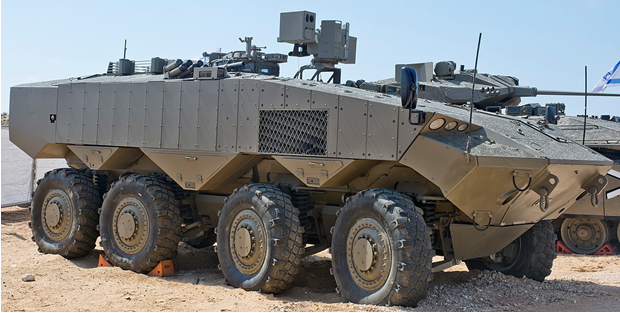
A Battalion Fighting Group (BFG) is a modular, mixed formation designed for dispersed, complex operations. Each BFG pairs a Fighting Tank battalion — redesigned or upgraded to prioritize survivability, close-support firepower and integration with active protection and counter-drone suites — and one or two Heavy APC (HAPC) battalions — heavily protected, well-armed carriers optimized for dismounted maneuver in urban and complex terrain.
Crucially, each BFG embeds organic fires (company-level 120 mm self-propelled mortars, battalion- 122 mm wheeled artillery), short-range air defense and anti-tank elements, and a dedicated complement of reconnaissance and attack UAVs/loitering munitions. The BFG is intended to be tactically autonomous — capable of holding, clearing and shaping a local area with minimal external augmentation — while operating within a higher-level networked C2 and fires architecture.
Rationale: BFGs are smaller, more numerous and more flexible than brigade centric formations. They permit rapid local concentration, persistent presence in contested urban zones, and distributed air-defense and counter-Drone coverage. Where threats are dispersed — tunnels hide sites, improvised urban defenses — BFGs provide the right mix of protection, mobility and precision lethality.
What a “fighting tank” should be
The concept of a “fighting tank” departs from conventional MBT design for asymmetric environments. Proposed attributes include a protected crew capsule and the adoption of an unmanned remote turret armed with a 57 mm or 76 mm automatic cannon — balancing precision air-burst and kinetic options; multi-layered active protection systems (hard-kill interceptors and close-in kinetic/fragmentation interceptors) and soft-kill EW suites tuned for ATGMs and swarm drones; integrated anti-drone systems (20–30 mm high-rate guns and directed EW) to defeat loitering munitions before they impact; and extensive sensor suites and 360° cameras to mitigate urban concealment and elevation vulnerabilities.
Practically, an interim path is to convert one Merkava Mk-3 brigade into a fighting-tank formation while pursuing procurement/upgrades of foreign chassis (e.g., surplus U.S. M-1s where politically feasible) adapted with Israeli electronics and protection systems.
Heavy APCs and assault platforms
Infantry mobility within BFGs must be heavily protected. Heavy APC proposals include upgraded indigenous platforms (Tiger variants) and selected foreign models (VN-series) enhanced with side-mounted remote weapon stations and AI-assisted situational awareness; interception posts and soft/hard countermeasures for flanks and rears; and a subset of Fighting APCs (FAPCs) — non-dismount direct-fire vehicles with 57 mm auto loading guns for urban fire support.
Company structures should be sized so that a BFG company typically fields 14 HAPCs and 4 AFVs (armor fighting vehicles), enabling depth, redundancy and protected dismount capacity.
The drone revolution: defense, offense, integration
Perhaps the most consequential change on the modern battlefield is the proliferation of drones and loitering munitions. The Russia-Ukraine theater has shown how low-cost aerial systems can reshape access, ISR, and strike options. For Israel, the priority must be comprehensive counter-Drone defenses layered at the BFG, base and strategic levels: electronic warfare, kinetic interceptors, point-defense Gatling gun and rapid attribution and strike capabilities against launch and production sites.
At the same time, BFGs must field organic loitering munitions and FPV drones (from short-range strike to longer-endurance loiterers) as a core tactical tool — for reconnaissance, precision suppression, and defeating hardened positions. Mass production and inventory scale matter; thousands, not dozens, will be necessary to saturate defenses and provide persistent ISR and strike.
Fires, C2 and networking
BFG effectiveness hinges on integration. Company mortars, guided 122 mm rockets and medium artillery must be networked into a common ISR-to-shooter fabric. Telescoping sensor masts, distributed ISR nodes and automated targeting links reduce sensor-to-shooter timelines and allow a small BFG to call precision fires and counter-Drone effects autonomously. Command nodes should be hardened, mobile, and capable of continued operation in contested EW environments.
Procurement and industrial strategy
Israel’s defense industry can design prototypes and unique systems; however, industrial throughput constrains rapid scaling. A pragmatic procurement approach blends domestic design and foreign manufacturing partners. Options include upgrading foreign surplus (e.g., M-1 tanks) to Israeli standards where diplomacy permits; licensed or OEM agreements with manufacturers of modern wheeled and tracked chassis (VT-4/Mark-96, VN-series) to accelerate HAPC production; and parallel mass production of low-cost loitering munitions and FPV platforms leveraging commercial components.
Political tradeoffs are real. Procuring heavy systems from China or Russia risks diplomatic friction — particularly with the United States. A diversified supplier base mitigates single-source risk but requires careful coordination to preserve strategic relationships.
Force generation and basing
An initial target of 50 BFGs provides a meaningful change in force posture. BFGs should be prioritized for deployment along Lebanon, in Judea and Samaria, and in the Arava — areas requiring persistent, flexible local responses. BCTs remain relevant: retain them on the Egyptian and Syrian fronts and as strategic reserves for higher-intensity contingency operations. Effective basing requires logistics hubs with hardened drone capabilities, rapid repair and re-arms facilities, and dispersed ammunition stocks to limit single-point vulnerabilities.
Institutional changes and training
Beyond equipment, doctrine and training must change. BFGs require small-unit initiative, decentralized command, combined arms training at company and battalion levels, and robust C2-under-stress exercises that simulate EW, drone saturation, and subterranean threats. Lessons learned cells — akin to the ground forces’ learning system — must be empowered to iterate tactics and materiel rapidly.
Closing analysis
Israel’s strategic environment demands an armored corps that can fight both symmetric and asymmetric wars — sometimes simultaneously. The current heavy-tank, Brigade-centric posture is ill-matched to a future in which loitering munitions, subterranean fighters and urban IEDs dominate the tactical picture. Battalion Fighting Groups — mixed, protected, networked and drone-enabled — offer a viable, operationally relevant reconfiguration. Paired with an urgent counter-Drone posture, selective foreign procurement and accelerated domestic scaling of loitering munitions, the Armored Corps can regain adaptability and survivability.
As Brig. Gen. Guy Hazut urged in his critique of recent operations — calling the management of the Gaza campaign “a very serious failure” — the armed forces’ response must be institutional and systemic, not merely rhetorical. Structural reform, material adaptation and a pragmatic procurement strategy are the concrete steps that can turn strategic intention into battlefield effect.


תגובות